
Lesson 1: Types of Numbers

Lesson 1: Types of Numbers

To begin the lesson, click the Interactive Notes button to print the Interactive Notes pages for this lesson.

Interactive Notes

Objectives


  • I can classify numbers as real, whole, natural, integers, rational, and irrational.
  • I can compare and order rational and irrational numbers.
  • I can plot rational numbers on a number line.
  • I can estimate to plot irrational numbers on a number line.

Why?


Understanding the vocabulary and terms used in math will make it easier for you to be successful in higher-level math courses.

Classifying terms, objects, and information is a skill you will use throughout life. For example, when planting a garden you might need to classify your plants according to their growing season and soil type.

Instructor Resources

Click below for additional instructor resources on these topics.

How to Support Students:

This part of the lesson is very rich in vocabulary and will require students to process quite a few terms and their definitions. It is a good idea to pause here and check in with students to make sure that they understand and are able to apply all of the terms that have been presented.

To support students:

  • Quiz students on the vocabulary terms covered in this part of the lesson (all of the terms listed in the vocabulary table, except irrational numbers). Students can respond verbally or record terms in writing.
    • For fun, make it a guessing game. Describe a term and have students try to guess the term.
  • Give students a different number and have them explain what categories it will fit into and why.
    • For fun, have students roll a die to come up with a number that they can classify.
  • If students need more help simplifying fractions, have them review Lesson 1 Simplifying Fractions Resource.

If students are having difficulty classifying rational numbers, have them review the notes in the digital lesson one category at a time. Ask students to discuss each category and review examples and non-examples of each category.

Wrapping Up the Lesson:

To wrap up the lesson students need to complete the summary portion of their Lesson 1 Interactive Notes. Once students have completed the summary, review their responses with them.

Have students discuss the parts of the lesson they feel confident about, and the ones they still find challenging. If a student rates a skill as a 5 or below they need more support on that skill before moving on to the next lesson.

For students that need more support:

  • Review the challenging part(s) of the lesson. Rewatch videos, and revisit the appropriate portions of the student’s interactive notes.
  • Complete any practice sheets that have not already been completed.
    • If all of the practice sheets have been completed, use the problems from the practice sheets as a guide for writing new problems with different numbers that the student can solve.
  • Revisit any problems that the student found challenging or did not solve correctly. Work together to determine the correct answer and review the steps needed to correctly solve the problem.

Provide students with an opportunity to ask any questions they have about the material that was covered in the lesson.

Once students are able to rate each part of the lesson with a score of 8 or above, indicating that they are confident with each skill, they are ready to move on to the Lesson 1 Mastery Check.

Materials

The following materials are needed for students and instructors to be successful with this lesson.
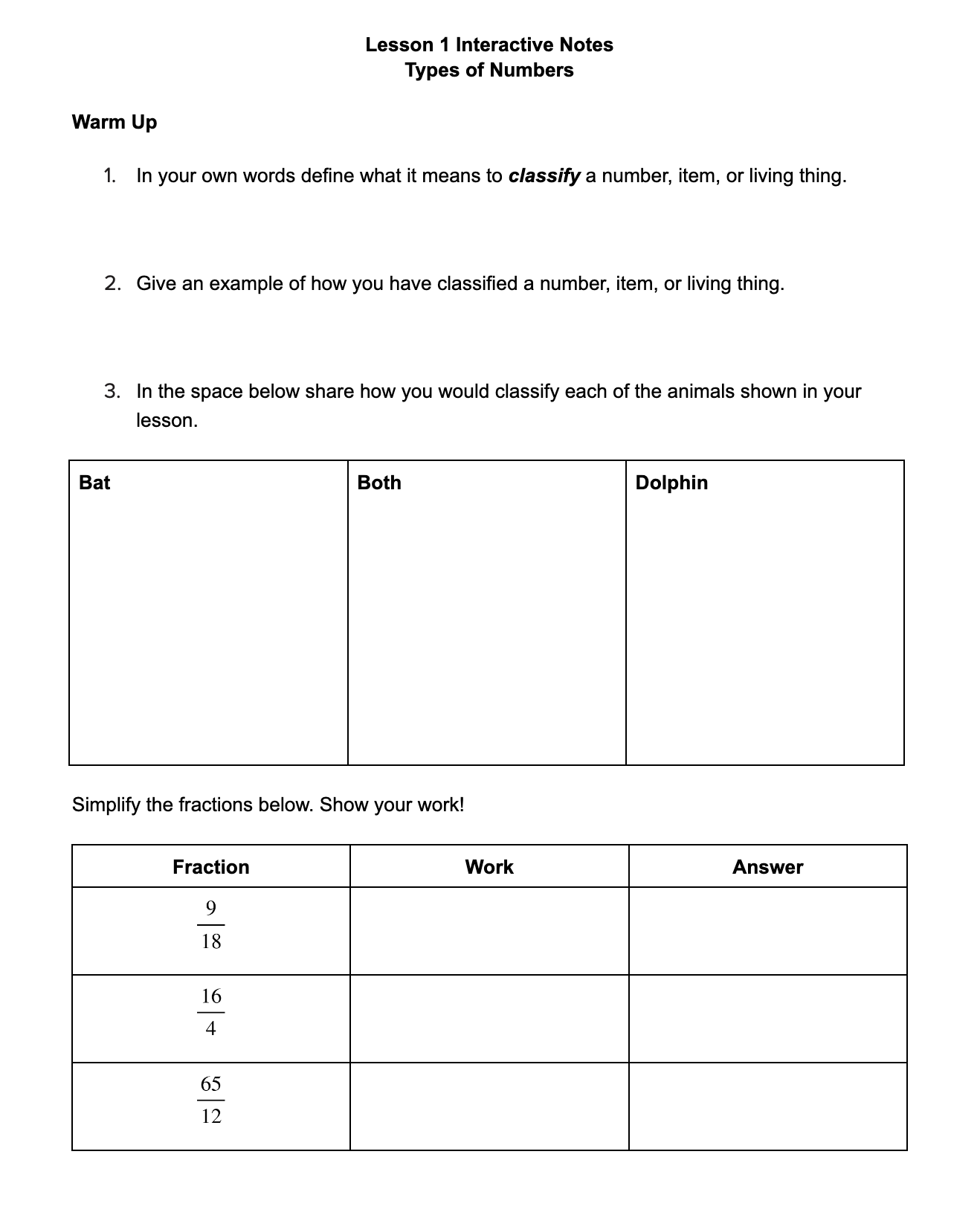
Lesson 1 Interactive Notes

Printed copy of the Lesson 1 Interactive Notes

Integer Block Kit
Math-U-See Integer Block Kit

You will use a set of Math-U-See Integer Blocks to complete the Lesson 1 – Apply It! Number Classification Student Activity. These blocks will also be helpful on the Lesson 1 – Mastery Check.
**If these blocks are not available you will need a set of small items such as coins, mini erasers, paper clips, etc.

Vocabulary

By the end of this lesson, you will be able to use and define each of the terms below correctly.

Integers include positive numbers, their negative opposites, and 0. Integers do not include decimals. Fractions are only integers, if their denominator is 1.

Irrational numbers include decimals that do not terminate or repeat, and numbers that can not be written as a fraction or a quotient of two integers.

Natural numbers are the positive whole integers. Natural numbers do not include 0.

Rational numbers can be written as the fraction or quotient of two integers. When the fraction is divided the quotient is a terminating decimal or a repeating decimal.

Real numbers include all of the numbers you have learned. Rational and irrational numbers are real numbers. The categories, sets, of rational and irrational numbers are subsets of real numbers.

Whole numbers include all positive integers and 0. Whole numbers do not include negative integers.

Complete the lesson components below, starting with the Warm Up.

Lesson Content
0% Complete 0/5 Steps