Explore
Explore
Now you are ready to explore the new learning of your lesson.
Work through each part of the lesson in the order they are listed below.
Complete each portion of your Lesson 1 Interactive Notes as you go.
In this lesson, you will focus on analyzing numbers and classifying them into categories, also known as sets, based on mathematical characteristics. To classify numbers correctly, you need to know the categories a number can be classified into. Each tab below will tell you all you need to know about the categories numbers can be classified into.
When you see the icon you will know that there are notes you will need to write down.
Turn to Part 1 in your Lesson 1 Interactive Notes. This is where you will record notes for this part of the lesson.
Are all numbers the same?
What do numbers have in common, and what makes them different?
Definition of Classification:
The process of arranging numbers, items, people, or places into categories based on their common characteristics.
In addition to classifying animals, items, and places, numbers can be classified into categories based on their mathematical properties. Sometimes numbers fit into more than one category.
Categories of Rational Numbers
Each tab will include notes that you will need to write down.
Record the definition, examples, and non-examples from each category in the corresponding portion of your Lesson 1 Interactive Notes.
Click on each tab of the interactive notes below to explore the categories that rational numbers can be classified into.
Definition of Natural Numbers:
Natural numbers are the positive whole integers. Natural numbers do not include 0. These are the numbers you use to count objects.
Examples of Natural Numbers:
Nonexamples of Natural Numbers:
Definition of Whole Numbers:
Whole numbers begin with 0, and are positive integers. Whole numbers do not include negative numbers.
Examples of Whole Numbers:
0, 1, 2, 3, 4, 5
983, 45, and 3,604
Nonexamples of Whole Numbers:
Definition of Integers:
Integers include positive numbers, negative numbers, and 0. Integers do not include decimals. Fractions are only integers, if they can be simplified to a denominator of 1.
This is the most specific category that negative numbers can be classified into.
Example of Integers:
Nonexample of Integers:
Definition of Rational Numbers:
Rational numbers can be written as the fraction or quotient of two integers. When the fraction is divided the quotient is a terminating decimal or a repeating decimal.
Example of Rational Numbers:
Nonexample of Rational Numbers:
Definition of Real Numbers:
Real numbers include all of the numbers you have learned so far. Rational and irrational numbers are a subset of real numbers.
Example of Real Numbers:
Nonexample of Real Numbers:
Fictional numbers such as twoteenth or firty.
Can you think of a situation where you would classify a fraction as either a natural number, whole number or integer?
Consider the following fraction, can it be classified as an integer?
All fractions are rational, but not all fractions can be classified as an integer, natural or whole number.
To determine if a fraction can be classified into these more specific categories, you need to simplify the fraction.
Follow the steps below to convert this improper fraction to a whole number.
Step 1:
List the multiples of 5
0, 5, 10, 15, 20, 25, 30, 35, 40…
Step 2:
5 and 30 are both multiples of 5, which means they can both be divided evenly by 5 with no remainder.
Step 3:
Divide both the numerator and denominator by 5,
Step 4:
The fraction can be simplified to
Step 5:
Fractions over a denominator of 1 represent whole groups of 1 or whole numbers.
The fraction is equal to the integer of 6.
Step 6:
Some fractions can be simplified to either a whole number, a natural number or an integer.
The answer is yes, this fraction can be classified as a natural number, whole number and an integer because it can be simplified to a whole number.
Try it Out and Explain!
Record your answers to the Part 1 Try it Out and Explain portions of your Interactive Notes.
Check Your Work
Try it Out and Explain!
Record your answers to the Part 1 Try it Out and Explain portions of your Interactive Notes.
Check your work after you have recorded your answers in your Interactive Notes.
Try it Out and Explain!
Record your answers to the Part 1 Try it Out and Explain portions of your Interactive Notes.
Checkpoint: Classifying Rational Numbers
Before exploring the next topic of this lesson, complete the checkpoint in your interactive notes.
Turn to Part 2 in your Lesson 1 Interactive Notes. This is where you will record notes for this part of the lesson.
Some numbers do not fit in the categories you have learned about so far.
Many of these numbers will fit into the category of irrational numbers.
What is an irrational number?
Record the definition, examples, and non-examples of irrational numbers in the corresponding portion of your Lesson 1 Interactive Notes.
Definition of Irrational Numbers:
Irrational numbers include decimals that do not terminate or repeat, and numbers that can not be written as a fraction or quotient of two integers.
Since irrational numbers do not terminate, an ellipse, which looks like “… “, is used to show that these numbers continue beyond the digits that are listed. When you see “…” that is a clue you are looking at an irrational number.
Examples of Irrational Numbers:
π, (3.1415926535…)
6.765438…
Nonexamples of Irrational Numbers:
Explain
Record your answer to the Part 2 Explain portion of your Interactive Notes.
Check Your Work
Checkpoint: Irrational Numbers
Before exploring the next topic of this lesson, complete the checkpoint in your interactive notes.
Turn to Part 3 in your Lesson 1 Interactive Notes. This is where you will record notes for this part of the lesson.
Classifying numbers is like solving a mystery. When detectives are working to solve a crime, they ask themselves a lot of questions as they work toward a solution.
When looking at a number you want to classify, ask yourself the questions below to narrow down which categories or sets your number can be placed into.
Questions to Ask Yourself
The questions you should consider when classifying a number are summarized in the tabs below. Record each question in the corresponding Questions to Ask Yourself portion in Part 3 of your Interactive Notes.
Click on each tab to review the questions used to classify numbers.
Question #1 When written as a decimal, does the decimal terminate or repeat?
Yes, the decimal terminates or repeats.
Decimals that terminate or repeat are classified as rational numbers.
There might be more specific categories that your rational number can be classified into.
Ask yourself the remaining questions to finish classifying your number.
No, the decimal does not terminate or repeat.
Decimals that do not terminate or repeat are irrational
If the value is irrational, it will not fit into any other categories. You have finished classifying the number.
Question #2 Does the value contain a fractional or decimal part?
Yes, the value contains a fractional or decimal part.
Positive and negative values that contain fractional and decimal parts can not be included in the integers category or any of the other more specific categories. You have finished classifying your number.
Note: If your value is a negative integer, it will not be classified into any more specific categories.
No, the value does not contain a fractional or decimal part.
Positive and negative values that do not contain fractional or decimal parts, can be classified as integers.
There might be more specific categories that your rational number can be classified into.
Ask yourself the remaining questions to finish classifying your number.
Question #3: Is the integer greater than 0?
Yes, the integer is greater than 0.
Positive integers greater than 0 can be classified as whole numbers and natural numbers.
No, the integer is equal to 0 but not greater than 0.
Natural numbers do not include 0. If your integer is equal to 0, it can be classified as a whole number but not a natural number.
Checkpoint: The Great Number Mystery
Before exploring the next topic of this lesson, complete the checkpoint in your interactive notes.
Turn to Part 4 in your Lesson 1 Interactive Notes. This is where you will record notes for this part of the lesson.
The diagram below is known as the Number Classification Diagram. You will use this diagram to classify rational and irrational numbers.
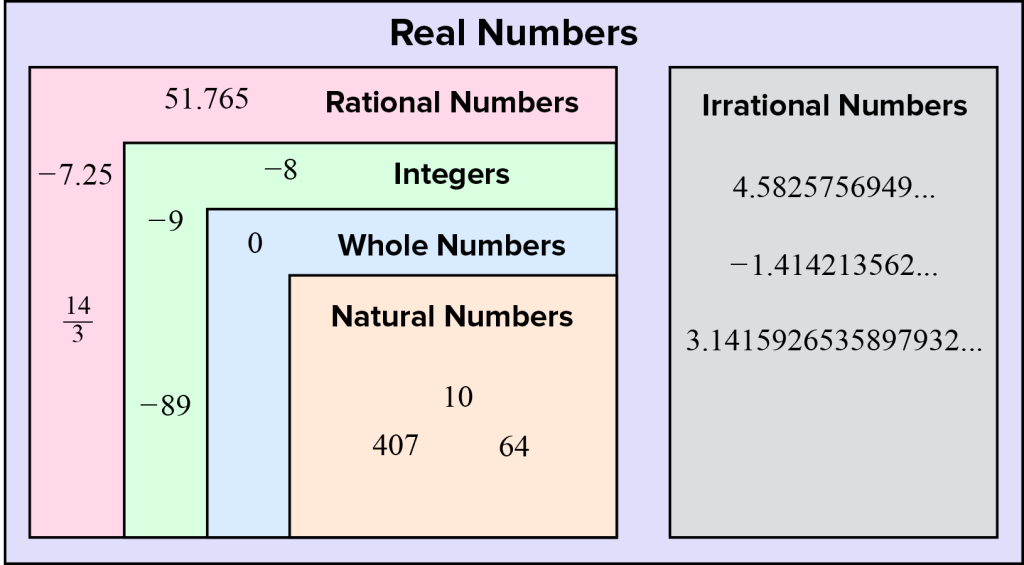
Notice that some of the categories are placed inside of other categories. This is to show that a number can be classified in multiple ways and many of the categories overlap.
When classifying a number, work your way down the categories until you reach a category the number does not fit into. Then back up one category, this is where you will place your number.
View the video below to learn more about classifying numbers using the Number Classification Diagram.
Classifying Rational and Irrational Numbers Video
Fill in the corresponding Video Notes in part 4 of your Lesson 1 Interactive Notes as you watch the video.
Click to watch the video.
Need a second look? Click on the Resource button below to view an example of a completed Number Classification Diagram and examples of each category.
Number Classification Activity Video
The Try it Out activity below will give you a chance to practice what you have learned about using the Number Classification Diagram.
View the Number Classification Activity Video to view how to complete this Try it Out in Part 4 of your interactive notes.
Click to watch the video.
Try it Out
Complete the activity in the Try It Out portion of Part 4 in your notes.
Check Your Work
Checkpoint: Number Classification Diagram
Before exploring the next topic of this lesson, complete the checkpoint in your interactive notes.
Turn to Part 5 in your Lesson 1 Interactive Notes. This is where you will record notes for this part of the lesson.
So far in this lesson, you have learned about rational and irrational numbers. Both types of numbers can be represented on number lines, but the process for plotting each type is different. This part of the lesson will focus on representing both rational and irrational numbers on number lines.
Plotting Integers and Larger Integers on a Number Line Video
Rational numbers are plotted according to their value.
In this video you will be plotting several whole numbers.
To get started let’s create a number line.
Click to watch the video.
Try it Out and Explain
Record your answers to the Try It Out and Explain portions of part 5 of your Lesson 1 Interactive Notes.
Check Your Work

Checkpoint: Plotting Integers on a Number Line
Before exploring the next topic of this lesson, complete the checkpoint in your interactive notes.
Turn to Part 6 in your Lesson 1 Interactive Notes. This is where you will record notes for this part of the lesson.
Fractions and mixed numbers are also rational numbers. Plotting these values is slightly different because they are between integers.
Plotting Fractions on a Number Line
Each of the tabs below will include notes that you will need to write down.
Record the steps used to plot fractions in the corresponding portion of your Lesson 1 Interactive Notes.
Step 1:
Let’s plot the fraction
.
is less than 1 and greater than 0
One-third will be plotted between 0 and 1 on the number line.
For this problem, you can create a number line that has a range of 0 to 1.
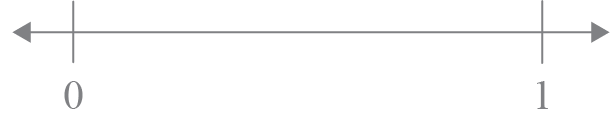
Step 2:
Divide the space between 0 and 1 into three segments.
Each segment is
of the value between 1 and 0.
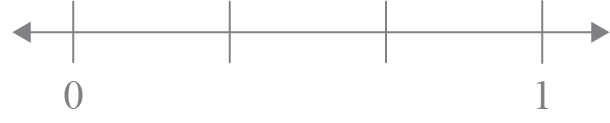
Step 3:
represents one of the three segments between 0 and 1.
Plot
on the first point between 0 and 1.
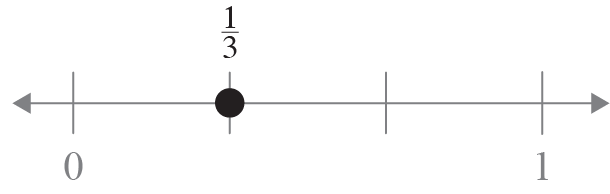
Let’s plot the fraction .
is less than 1 and greater than 0
One-third will be plotted between 0 and 1 on the number line.
For this problem, you can create a number line that has a range of 0 to 1.
Divide the space between 0 and 1 into three segments.
Each segment is of the value between 1 and 0.
represents one of the three segments between 0 and 1.
Plot on the first point between 0 and 1.
Plotting Mixed Numbers on a Number Line
Mixed numbers are plotted in the same way as fractions.
Each of the tabs below will include notes that you will need to write down.
Record the steps used to plot mixed numbers in the corresponding portion of your Lesson 1 Interactive Notes.
Let’s plot on the number line.
is between the whole numbers 5 and 6.
The mixed number represents a value that is greater than 5, but less than 6.
For this problem, you can create a number line with the range of 5 to 6.
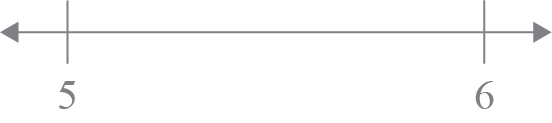
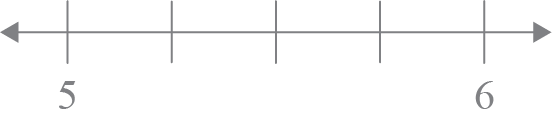
Divide the space between 5 and 6 into four segments.
Each segment is of the value between 5 and 6.
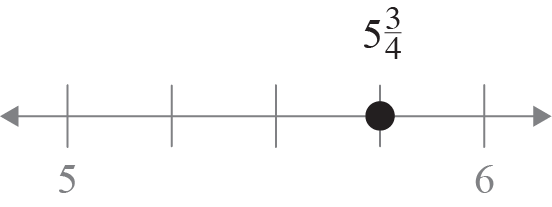
The whole number 5 indicates that will be plotted after the 5 but before the 6.
The fraction indicates that should be plotted on the the third segment between 5 and 6.
Try it Out and Explain
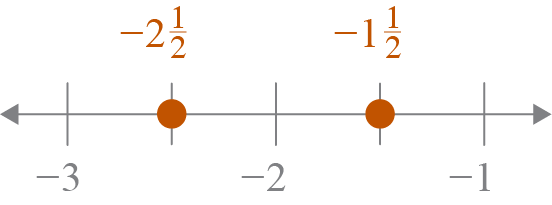
Record your answers to the Try It Out and Explain portions of part 6 of your Lesson 1 Interactive Notes.
Check Your Work
Checkpoint: Plotting Fractions and Mixed Numbers on a Number Line
Before exploring the next topic of this lesson, complete the checkpoint in your interactive notes.
Turn to Part 7 in your Lesson 1 Interactive Notes. This is where you will record notes for this part of the lesson.
Decimals represent the values between two integers.
Plotting rational decimals on a number line is very similar to plotting fractions and mixed numbers.
Follow the steps in each of the tabs below to practice plotting rational decimals on a number line. When you have completed all four steps you will have successfully plotted the decimal −6.15.
Determine which integers the decimal is between.
−6.15 is between the integers of −6 and −7.
Draw a number line that extends from one integer to the other.
For this example, your number line should extend from 7 to 8.

Divide your number line into segments that represent the values of the decimals you need to plot.
For this, you will need to look at the digits in the decimal places.
The digits in the decimal places of −6.15 are .15.
.15 is between 0.1 and 0.2
Divide your number line into segments that represent tenths.

Plot your point(s).
−6.15 is between −6.1 and −6.2.
Plot −6.15 in the middle of −6.1 and −6.2.
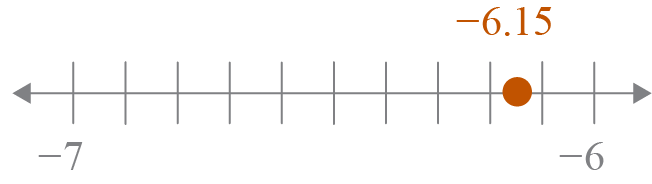
Use what you have learned from the example above to plot the rational decimals below.
Try it Out and Explain
Record your answers to the Try It Out and Explain portions of part 7 of your Lesson 1 Interactive Notes.
Check Your Work
Checkpoint: Plotting Rational Decimals on a Number Line
Before exploring the next topic of this lesson, complete the checkpoint in your interactive notes.
Turn to Part 8 in your Lesson 1 Interactive Notes. This is where you will record notes for this part of the lesson.
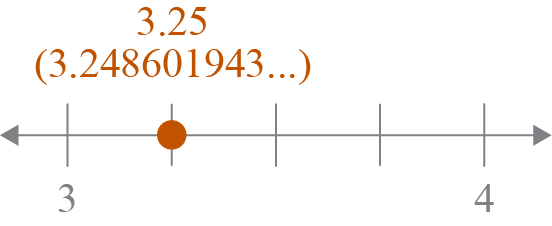
Where would you plot the irrational number 2.236067975…?
2.236067975… has a lot of digits. Fortunately, you don’t need all of these digits to accurately plot this decimal on the number line.
Work through the steps below to learn how to plot irrational numbers, like 2.236067975… on a number line.
View the Plotting Irrational Numbers on a Number Line Video to see an example of how to use rounding and estimation to plot on an irrational number, like 3.248601943…., on a number line.
Plotting Irrational Numbers on a Number Line Video
Fill in the corresponding Video Notes in part 8 of your Lesson 1 Interactive Notes as you watch the video.
Click to watch the video.
For this problem, round 2.236067975… to the nearest hundredth.
You can shorten your number to 2.236.
The 3 is in the hundredths, and 6 is one place to the right in the thousandths place.
6 has enough value to round the 3 up to a 4
Your rounded number is 2.24
2.24 is between the integers 2 and 3.
It is also close to the decimal 2.25.
This means that you can use an interval of 0.25 for your number line.
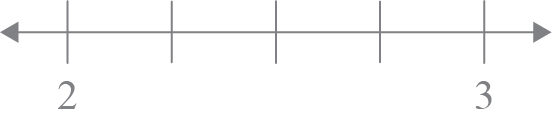
2.24 is one hundredth less than 2.25
This means it can be plotted just to the left of 2.25.
This is the best estimate of where to plot the irrational number 2.236067975… on a number line.
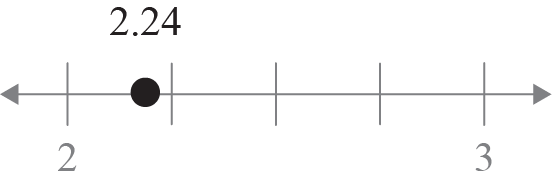
Try it Out and Explain
Record your answers to the Try It Out and Explain portions of part 8 of your Lesson 1 Interactive Notes.
Check Your Work
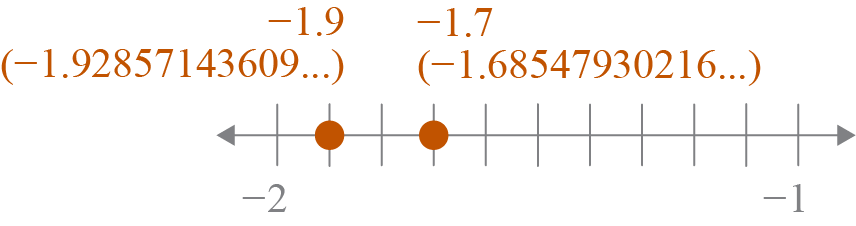

Checkpoint: Plotting Irrational Numbers on a Number Line
Before exploring the next topic of this lesson, complete the checkpoint in your interactive notes.
Student Reflection
Complete the Summary portion in your Lesson 1 Interactive Notes.
You have earned a new achievement!
Click on the badge below to reveal what you’ve earned.