
Lesson 8: Square and Cube Roots
Lesson 8: Square Roots and Cube Roots
To begin the lesson, print the Interactive Notes using the button below.
Follow along with our lesson content guide starting with the Warm Up.
Digital Lesson Content and Videos
Login to the Digital Toolbox to access the digital content and videos for our lesson.
Lesson 8 Interactive Notes
These can be printed or used digitally, whichever method you and your instructor prefer.
Instructor Content
Throughout the lesson, you will notice buttons labeled “Instructor Content”. These buttons provide access to helpful tips and resources aimed at helping instructors support students.
CalculatorCalculatorCalculator
By the end of this lesson, you will have learned the skills below.
Objective 1: I can identify the difference between cube and square roots.
Objective 2: I can calculate square and cube roots.
Objective 3: I can estimate imperfect square and cube roots.
Objective 4: I can simplify square roots by factoring out perfect squares and using prime factorization.
Objective 5: I can evaluate equations and real-world problems that include radicals.
Throughout this lesson, you will use the vocabulary below.
Cubing a number means to multiply it by itself three times.
A cube root is one of three identical factors when multiplied produces a perfect cube.
Example:
3 is the cube root of 27
A number multiplied by itself three times.
Example:
8 is a perfect cube.
The product of a number multiplied by itself.
Example:
25 is a perfect square.
25 is the product of
The positive square root of a number.
Unless a problem asks you to calculate all possible roots of a number, you will list the primary root of the number.
Example:
5 is the positive root of 25, therefore, 5 is the primary root of 25
The symbol used to represent roots.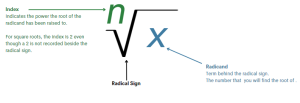
The negative root of a number.
Example:
-5 is the negative root of 25, therefore, -5 is the secondary root of 25
Squaring a number means to multiply a number by itself.
A square root is one of two identical factors whose product is a perfect square.
Example:
6 is the square root of 36
Recorded behind the radical sign.
This is the value whose root is being calculated.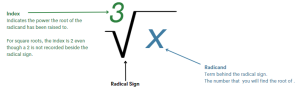
Example
16 is the radicand
This expression will be simplified by calculating the square root of 16.
The values recorded in conjunction with a radical sign.
This includes the index, radical sign, and radicand.
Example
is a radical term.
The value recorded to the upper left corner of the radical sign.
The index indicates the root that is to be taken.
When no value is recorded, the index is assumed to be 2, and the square root will be taken.
Example
The index is 3, the cube root of 64 will be calculated.
Example
The index is assumed to be 2, the square root of 25 will be calculated.
Why is this lesson important to me?
Square roots and cube roots have many uses in real life. These calculations are very common in measurement, finance, and engineering.