
Part 3: Estimating Roots_L08_U02_C3 Math_2023_Ready for Review
Part 3: Estimating Roots
Complete Part 3 of your Lesson 8 Interactive Notes as you work through your lesson.
Not all numbers are perfect squares or perfect cubes.
How do you calculate the roots of numbers that are neither perfect squares or perfect cubes?
Consider the expression
How would you calculate the square root of 28 if it is not a perfect square?
To calculate the roots of imperfect squares and cubes, estimation can be used, especially when you don’t need to know the exact root.
Watch the Estimating Roots video to learn more about calculating the roots of imperfect squares and cubes. While watching, complete the Video Notes portion of your Lesson 8 Interactive Notes.
***Insert Estimating Roots Video — Create video that estimates perfect square — use __<__<___ notation
Estimating Cube Roots
As you saw in the video, estimation is used to calculate the approximate root of imperfect squares. This same strategy can be applied to find the root of imperfect cubes.
Work through the tabs below to learn how to estimate the roots of imperfect cubes. Then complete the corresponding section of your Lesson 8 Interactive Notes.
Steps Used to Estimate Cube Roots
Let’s use the example of
57 is not a perfect cube.
The first step is to determine what two perfect cubes 57 is located between.
Lower Cube Root: 27
Upper Cube Root: 64
57 is located between the perfect cubes of 27 and 64.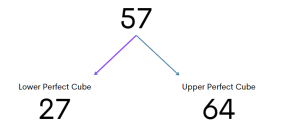
Calculate the cube roots of both the upper and lower perfect cubes.
The is between the and .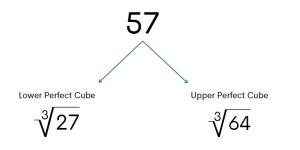

The estimated cube root of 57 is between 3 and 4.
Plot the estimated on a number line by first finding the difference between these values to determine if 57 is closer to 27 or 64.
57 is 30 units away from 27 and 7 units away from 64.
is closer to the .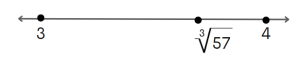
Try it out!
Estimate the roots below.
Plot each estimated root on a number line between the closest upper and lower perfect roots.
Plot the estimated cube root of 57 on a number line.
On a number line, the approximate location of will be closer to .
***Text to be included when solution button is clicked
Compare your solutions to those shown below.
Lower Perfect Square: 81
Upper Perfect Square: 100
The estimated square root of 95 is between 9 and 10.
Subtract to determine which perfect square the estimated square root of 95 is closer to.
The estimated square root of 95 is closer to the square root of 100.
On a number line the approximate location of the square root of 95 will be closer to 10.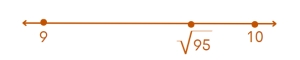 Lower Perfect Cube: 8
Upper Perfect Cube: 27
The estimated square root of 15 is between 2 and 3.
Subtract to determine which perfect cube the estimated cube root of 15 is closer to.
The estimated cube root of 15 is closer to the cube root of 8.
On a number line, the approximate location of the cube root of 15 will be closer to 2.
Lower Perfect Square: 16
Upper Perfect Square: 25
The estimated square root of 19 is between 4 and 5.
Subtract to determine which perfect square the estimated square root of 19 is closer to.
The estimated square root of 19 is closer to 4.
On a number line, the approximate location of the square root of 19 will be closer to 4.
Lower Perfect Cube: 216
Upper Perfect Cube: 343
The estimated cube root of 300 is between 6 and 7.
Subtract to determine which perfect cube the estimated cube root of 300 is closer to.
The estimated cube root of 300 is closer to 7.
On a number line, the approximate location of the cube root of 300 will be closer to 7.
Lower Perfect Cube: 512
Upper Perfect Cube: 729
The estimated cube root of 650 is between 8 and 9.
Subtract to determine which perfect cube the estimated cube root of 650 is closer to.
The estimated cube root of 650 is closer to 9.
On a number line, the approximate location of the cube root of 650 will be closer to 9.
***END solution button text
**Instructor Notes – Text will appear when button is clicked
How to Support Students:
The following activities can be used to support students that need additional practice or enrichment on estimating roots.
- Matching
- Option 1: Students will match an imperfect square or cube to the perfect squares or cubes that it is located between.
- Option 2: Students will match imperfect squares and cubes to number lines that represent their estimated roots.