
Part 4: Simplifying Square Roots_L08_U02_C3 Math_Ready for Review
Part 4: Simplifying Square Roots
Complete Part 4 of your Lesson 8 Interactive Notes as you work through your lesson.
Square roots are simplified to make them easier to use and more relatable. The square root of many imperfect squares tend to be long numbers with many digits in the decimal places. When the actual square root is not needed, imperfect squares can be simplified to a more usable form with fewer digits to keep track of.
This part of the lesson will explain the two ways to simplify imperfect squares – factoring out perfect squares and prime factorization.
Factoring Out Perfect Squares
One way to simplify imperfect squares is to determine if any factors of the number are perfect squares.
As you work through the examples below, complete the corresponding portion of your Lesson 8 Interactive Notes.
Simplify
Step 1
List the factors of 80.
80: 1, 2, 4, 5, 8, 10, 16, 20, 40, 80
Step 2
Highlight, circle, or underline any factors that are perfect squares.
80: 1, 2, 4, 5, 8, 10, 16, 20, 40, 80
4 and 16 are both perfect squares.
When more than one factor is a perfect square, factor out the largest perfect square.
16 is the largest perfect square.
Step 3
Rewrite the expression with the perfect square factored out.
Both factors should be recorded under radical signs.
Step 4
Simplify the perfect square, then rewrite the expression as a product of the root of the perfect square multiplied by the square root of the remaining factor.
simplifies to 4.
5 is not a perfect square, therefore it will remain under the radical sign.
Rewrite the expression as the product of 4 times the square root of 5.
Final Simplified Expression:
Simplify
Step 1
List the factors of 96.
96: 1, 2, 3, 4, 6, 8, 12, 16, 24, 32, 48, 96
Step 2
Highlight, circle or underline any factors that are perfect squares.
96: 1, 2, 3, 4, 6, 8, 12, 16, 24, 32, 48, 96
4 and 16 are both perfect squares.
When more than one factor is a perfect square, factor out the largest perfect square.
16 is the largest perfect square.
Step 3
Rewrite the expression with the perfect square factored out.
Both factors should be recorded under radical signs.
Step 4
Simplify the perfect square, then rewrite the expression as a product of the root of the perfect square multiplied by the square root of the remaining factor.
simplifies to 4.
6 is not a perfect square, therefore, it can remain under the radical sign.
Rewrite the expression as the product of 4 times the square root of 6.
Final Simplified Expression:
Simplify
Step 1
List the factors of 150.
150: 1, 2, 3, 5, 6, 10, 15, 25, 30, 50, 75, 150
Step 2
Highlight, circle, or underline any factors that are perfect squares.
150: 1, 2, 3, 5, 6, 10, 15, 25, 30, 50, 75, 150
25 is the only factor of 150 that is a perfect square.
Step 3
Rewrite the expression with the perfect square factored out.
Both factors should be recorded under radical signs.
Step 4
Simplify the perfect square, then rewrite the expression as a product of the root of the perfect square multiplied by the square root of the remaining factor.
simplifies to 5.
6 is not a perfect square, therefore, it can remain under the radical sign.
Rewrite the expression as the product of 5 times the square root of 6.
Final Simplified Expression:
Try it out!
Simplify each expression by factoring out the perfect squares.
***Solution text below.
Factors of 45: 1, 3, 5, 9, 15, 45
9 is the only factor of 45 that is a perfect square.
Factors of 72: 1, 2, 3, 4, 6, 8, 9, 12, 18, 24, 36, 72
4,9, and 36 are all perfect squares.
When more than one factor is a perfect square, factor out the largest perfect square.
36 is the largest perfect square.
Factors of 98: 1, 2, 7, 14, 49, 98
49 is the only factor that is a perfect square.
Factors of 243: 1, 3, 9, 27, 81, 243
9 and 81 are perfect squares.
When more than one factor is a perfect square, factor out the largest perfect square.
81 is the largest perfect square.
***End solution text
Prime Factorization
Prime factorization is another way to simplify square roots.
This method is particularly helpful with imperfect squares that are not the product of perfect squares.
View the Simplifying Square Roots with Prime Factorization Video to learn more about this strategy.
While watching the video, complete the corresponding portion of your Lesson 8 Interactive Notes.
**Insert video – Include an example that can not be simplified
Try it out!
Step 1: Construct a factor tree to determine the prime factorization of each value below.
Step 2: Simplify each imperfect square using the prime factorization of each value.
**Solution text below.
Compare your solutions to those shown below.
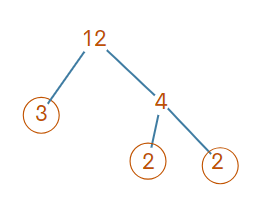
Prime Factorization of 12: 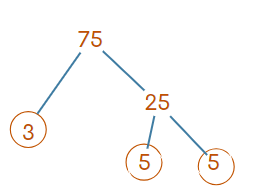
Prime Factorization of 75:  Prime Factorization of 58: There are no like factors to group.
The square root of 58 can not be simplified.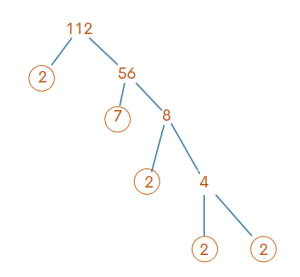 Prime Factorization of 112:
**end solution text
**Instructor Notes – Text will appear when button is clicked
How to Support Students:
The following activities can be used to support students that need additional practice or enrichment on estimating roots.
- Matching
- Students will match an imperfect square to its simplified form.