
Checkpoint
To continue past this checkpoint, students should confidently and correctly answer this problem.
Watch topic videos, fill in guided notes and examples, and complete Checkpoints.
Refer to your student’s print out or Student Worktext for this lesson section and video. Students will complete the guided notes section as they watch the video.
Refer to your student’s print out or Student Worktext for each example. Students will follow along and complete the examples as they watch the videos.
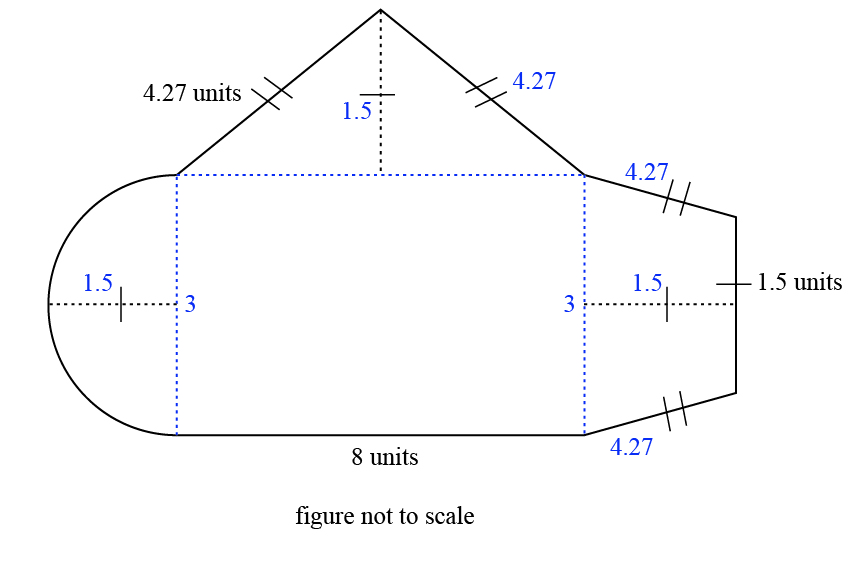
Implement
Shapes: rectangle, semi-circle, triangle, trapezoid
Formulas:
Explain
Rational and irrational numbers cannot be added together here. Pi is an irrational number with an estimated value of 3.14 but the directions say to leave in terms of pi. (See A1:PSM for more about number classification)
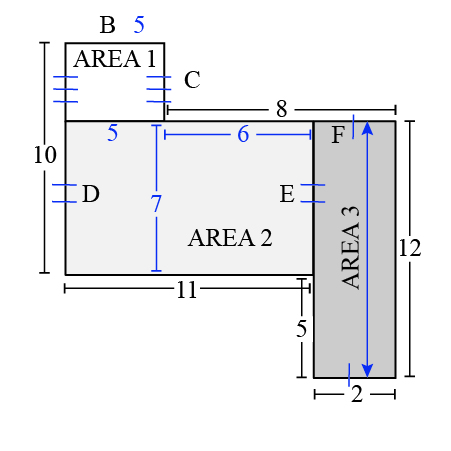
F = 2
E = D = 12 – 5 = 7
C = 10 – D = 10 – 7 = 3
B = 11 – (8 – 2) = 5
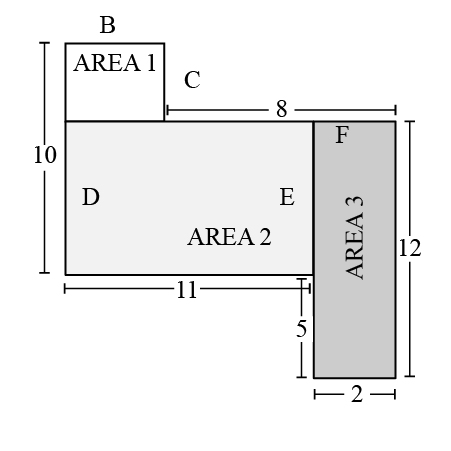
Area 1 = (5)(3) = 15 sq units
Area 2 = (11)(7) = 77 sq units
Area 3 = (2)(12) = 24 sq units
Have your student mark their figure for things they know have the same length. Their figure does not have to have the same markings as the key.
To continue past this checkpoint, students should confidently and correctly answer this problem.
triangle base = width of rectangle
A = lw
330 = 30l
l = 22 feet
Q: What formulas will you need for this problem?
A: Area of a rectangle and area of a triangle
Q: How are the two figures related?
A: The base of the triangle is the width of the rectangle, so they will be the same length.
Q: Is it possible to determine the perimeter for the composite figure? Explain.
A: No, because the sides of the triangle are unknown.