
Part A: Mastery Check
Your student will demonstrate mastery of the math concepts they have just learned.
Print or open your Student Worktext to the Mastery Check.
Show What You Know
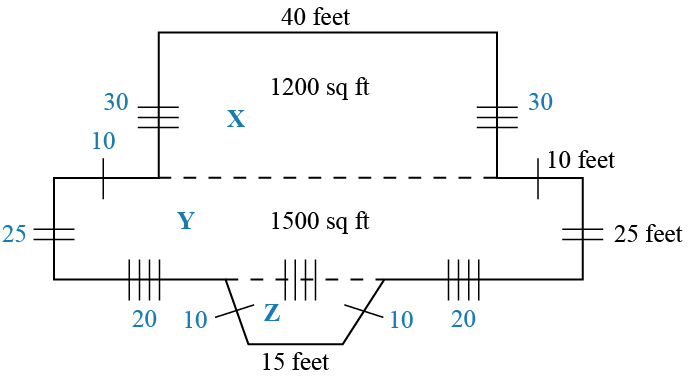
X: A = lw
1200 = 40w
w = 30 ft
Z: sides are 10 ft
P = sum of all sides
P = 40 + 2(30) + 4(10) + 2(25) + 2(20) + 15
P = 245
Fiber optic line:
245 ft * 6.25 = 1531.25 feet of fiber optic line
Your student will need to use the given square footage to find some of the missing side lengths. Remind your student that all the same markings mean that those sides have equal length.
Q: Why is knowing the square footage helpful in finding the perimeter?
A: Because you can use the square footage and a given side to find the missing side length by working backwards.
Q: Why do you need the perimeter of the building?
A: Because you need to multiply the perimeter by 6.25 to find the total amount of fiber optic line needed.
Say What You Know
Your student should be able to restate the objectives of the lesson in their own words. If your student is unable to restate the lesson objectives, have them go back and reread the objectives and then explain them.
- Objective 1
- Objective 2